
DANA 4840 — K-means (MacQueen): Worksheet 2, two variables and WSS
K-means partitions points into k groups by alternating: assign each point to the nearest centroid, then recompute centroids as the mean of their members. With MacQueen’s rule (R option algorithm = "MacQueen"), updates follow that textbook sequence.
For two centers, kmeans(..., centers = 2) picks starting centers at random. To fix centres exactly at observations A and C, pass centers as a 2 × p matrix whose rows are those coordinates (see ?kmeans, argument centers).
Data (four items, two features)
| Item | x1 | x2 |
|---|---|---|
| A | 5 | 3 |
| B | −1 | 1 |
| C | 1 | −2 |
| D | −3 | −2 |
Initial centroids: row A → (5, 3); row C → (1, −2).
Squared Euclidean distance
(d^2(\mathbf{x},\mathbf{c}) = (x_1-c_1)^2 + (x_2-c_2)^2)
gives the same nearest-centre decisions as ordinary Euclidean distance.
Distances from each item to A and to C
| Item | (d^2) to A (5,3) | (d^2) to C (1,−2) | Nearest |
|---|---|---|---|
| A | 0 | 41 | A |
| B | 40 | 13 | C |
| C | 41 | 0 | C |
| D | 89 | 16 | C |
Example B: ((-1-5)^2 + (1-3)^2 = 36+4 = 40) to A; ((-1-1)^2 + (1+2)^2 = 4+9 = 13) to C ⇒ cluster of C.
First assignment
| Cluster | Members |
|---|---|
| 1 | A |
| 2 | B, C, D |
Update centroids
Cluster 1 mean: (5, 3) (only A).
Cluster 2 mean of B, C, D:
(\bar x_1 = \frac{-1+1-3}{3} = -1), (\bar x_2 = \frac{1-2-2}{3} = -1) → (−1, −1).
Second assignment (same centroids)
Distances to (5, 3) vs (−1, −1) leave A in cluster 1 and B, C, D in cluster 2 — no moves ⇒ convergence.
Final partition
| Item | Cluster |
|---|---|
| A | 1 |
| B | 2 |
| C | 2 |
| D | 2 |
Final centroids: (5, 3) and (−1, −1).
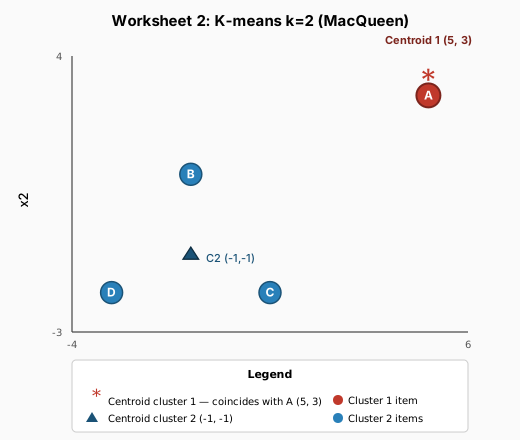
The figure shows both centroids: a red star marks centroid 1 at (5, 3) (same location as A); a triangle marks centroid 2 at (−1, −1).
R code — reproduce the plot (base graphics)
Use xlim / ylim wide enough so A (5, 3) stays inside the panel. asp = 1 keeps Euclidean distances visually faithful.
x1 <- c(5, -1, 1, -3)
x2 <- c(3, 1, -2, -2)
labs <- c("A", "B", "C", "D")

plot(
  x1, x2,
  type = "n",
  xlim = c(-4, 6),
  ylim = c(-3, 4),
  asp  = 1,
  xlab = "x1",
  ylab = "x2",
  main = "Worksheet 2: K-means k=2 (MacQueen)"
)
abline(h = 0, v = 0, col = "gray90", lty = 3)

## Centroidos finales: estrella = C1, triángulo = C2 (pch 8 y 17)
points(5, 3, pch = 8, col = "darkred", cex = 2.2, lwd = 2)
points(-1, -1, pch = 17, col = "darkblue", cex = 2, lwd = 2)

## Ítems: A cluster 1 (rojo), B C D cluster 2 (azul)
points(x1[1], x2[1], pch = 16, col = "firebrick", cex = 1.6)
points(x1[-1], x2[-1], pch = 16, col = "steelblue", cex = 1.6)

text(x1, x2, labels = labs, pos = 3, offset = 0.45, font = 2)

legend(
  "bottomleft",
  legend = c(
    "Centroid 1 (5, 3)",
    "Centroid 2 (-1, -1)",
    "Items cluster 1",
    "Items cluster 2"
  ),
  pch = c(8, 17, 16, 16),
  pt.cex = c(1.8, 1.5, 1.2, 1.2),
  col = c("darkred", "darkblue", "firebrick", "steelblue"),
  bty = "n",
  cex = 0.85
)
R: centers as a matrix + MacQueen
## Tabla del enunciado
df <- data.frame(
  item = c("A", "B", "C", "D"),
  x1   = c(5, -1, 1, -3),
  x2   = c(3, 1, -2, -2),
  stringsAsFactors = FALSE
)

## Solo columnas numéricas; los nombres de fila etiquetan los ítems
X <- as.matrix(df[, c("x1", "x2")])
rownames(X) <- df$item

## Matriz 2×2: fila 1 = centro inicial A, fila 2 = centro inicial C
## (no usar centers = 2 aquí: eso pediría puntos iniciales aleatorios)
initial_centers <- X[c("A", "C"), , drop = FALSE]

km <- kmeans(
  x         = X,
  centers   = initial_centers,
  algorithm = "MacQueen"
)

km$cluster   # etiquetas 1 o 2 por fila de X
km$centers   # centroides finales (una fila por cluster)
km$withinss  # WSS dentro de cada cluster
km$tot.withinss
A B C D
1 2 2 2
     x1 x2
1  5  3
2 -1 -1
[1]  0 14
[1] 14
Reading the output: cluster uses integers 1 and 2 only as labels; centers rows need not follow item order A–D. withinss[c] is (\sum_{i \in \text{cluster } c} d^2(\mathbf{x}_i, \bar{\mathbf{x}}_c)) with squared Euclidean distance inside kmeans.
Total within-cluster sum of squares (part after (a))
Cluster 1 (only A at its centroid): contribution 0.
Cluster 2, centroid (−1, −1):
| Item | Squared distance to (−1,−1) |
|---|---|
| B (−1, 1) | ((0)^2 + (2)^2 = 4) |
| C (1, −2) | ((2)^2 + (-1)^2 = 5) |
| D (−3, −2) | ((-2)^2 + (-1)^2 = 5) |
WSS₂ = 4 + 5 + 5 = 14, total WSS = 0 + 14 = 14, matching km$tot.withinss.
See also
- Distance measures — Euclidean setup before clustering.
- Clustering tendency — sanity checks before forcing k partitions.